
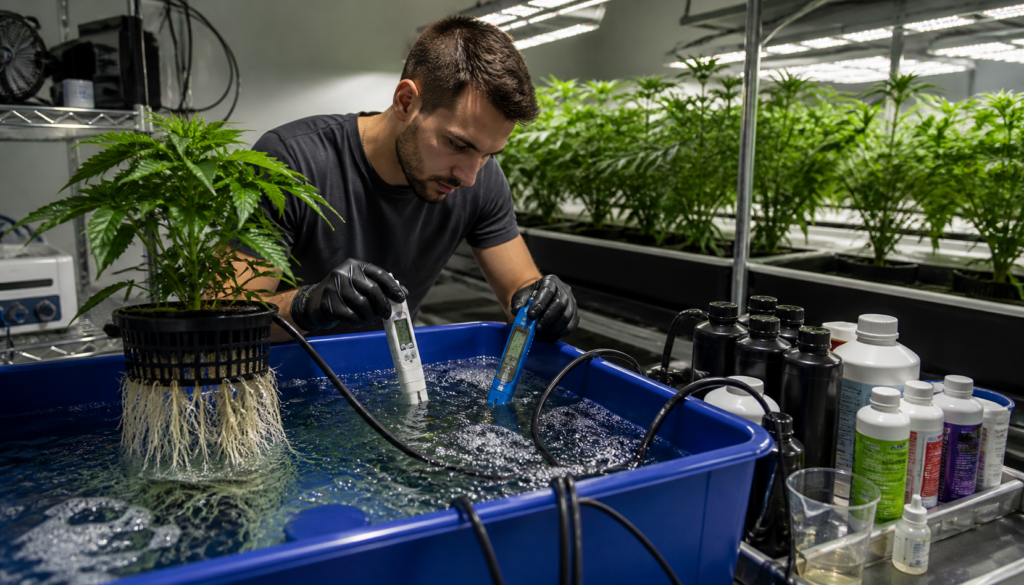
When a hydroponic plant turns yellow, slows down, burns at the tips, or shows strange new growth, the natural reaction is to add more nutrients. In many cases, that is the exact move that makes the problem worse.
Nutrient lockout in hydroponics happens when nutrients are present in the reservoir, but the plant cannot properly access or use them. The issue may be pH drift, high EC, poor water quality, low oxygen, warm root-zone conditions, unbalanced nutrients, salt buildup, or stressed roots. As professionals who help growers troubleshoot these problems daily, our first advice is simple: test before you feed.
Table of Contents
What Is Nutrient Lockout in Hydroponics, and Why Does It Happen?
Nutrient lockout happens when nutrients are present in the reservoir, but roots cannot absorb them efficiently because pH, EC, water quality, oxygen, or root health is out of range. In hydroponics, pH, EC, alkalinity, dissolved oxygen, and water temperature all influence nutrient availability and root performance [1][2].
Hydroponic systems react quickly because the root zone has less buffering than soil. In soil, organic matter and mineral particles can soften sudden changes. In water culture, NFT, drip hydro, aeroponics, and recirculating systems, a reservoir mistake can show up fast. A pH swing overnight, an EC spike after top-offs, or a warm reservoir with poor oxygen can turn into visible stress before the grower realizes what changed [1][3].
Grow Big Pro Tip: Do not add more nutrients until pH and EC are verified. If the plant is locked out, more fertilizer can raise EC, increase stress, and make the roots work harder.
How Can You Tell Lockout Apart From a True Deficiency?
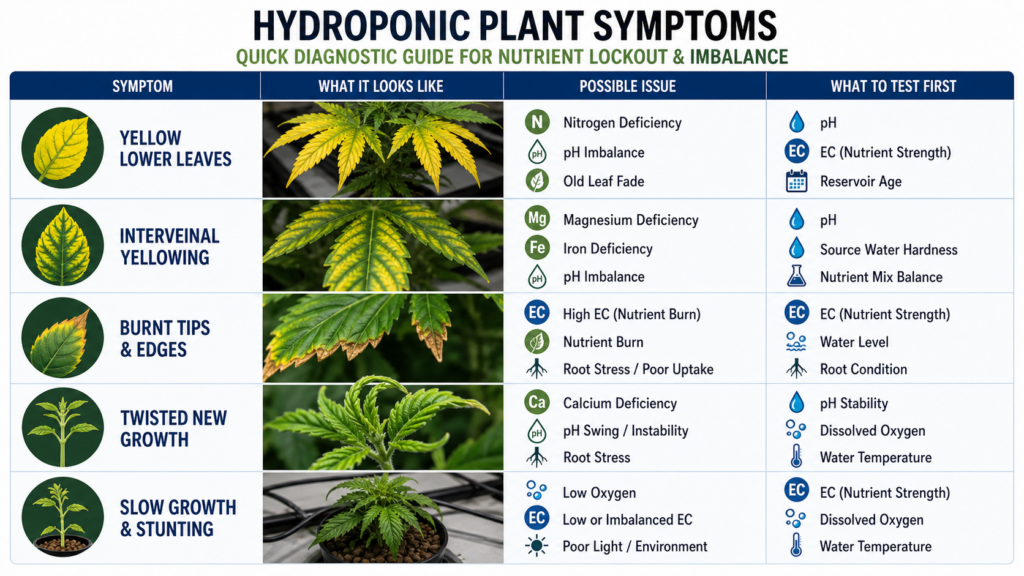
Start with symptoms, then prove it with readings: A true deficiency means the plant does not have enough of a nutrient available in the system. Lockout means the nutrient may be present, but unavailable. Toxicity or nutrient burn means the concentration may be too strong. Unfortunately, all three can look similar from across the room.
Common warning signs include yellowing leaves, interveinal chlorosis, burnt tips, dark clawing, twisted new growth, purple stems, weak roots, stalled uptake, or plants drinking water but not using nutrients normally. Symptom charts help, but they are not enough on their own because pH, EC, water quality, and root health can stack together [1][3].
| Symptom | Possible Issue | What to Test First |
|---|---|---|
| Yellow lower leaves | Nitrogen shortage, pH issue, old leaf fade | pH, EC, reservoir age |
| Interveinal yellowing | Magnesium, iron, pH imbalance | pH, source water hardness |
| Burnt tips | High EC, nutrient burn, root stress | EC, water level, root condition |
| Twisted new growth | Calcium issue, pH swing, root stress | pH stability, oxygen, temperature |
| Slow growth | Low oxygen, low EC, high EC, poor light | EC, dissolved oxygen, water temperature |
Mini-summary: If the reservoir is full but the plant looks hungry, assume nothing. Measure pH and EC, inspect the roots, check water temperature, and review what changed in the last 72 hours.
What pH Range Should You Check First?
For many hydroponic crops, the first pH check should confirm whether the reservoir is near the common 5.5 to 6.5 target zone before any feeding changes are made. One technical guide lists nutrient solution pH for soilless culture between 5 and 6, often around 5.5, to help maintain the root environment around 6 to 6.5 [1]. Another home hydroponics guide notes that 5.5 to 7.0 can be workable for many home systems [5].
When pH drifts too high, iron, manganese, zinc, copper, boron, and phosphorus availability can become a concern. When pH is too low, calcium, magnesium, sulfur, and molybdenum availability can become more difficult, and root stress may increase [6]. This is why pH issues often look like several deficiencies at once.
Compact pH chart:
Acidic concern: below 5.0, higher risk of root stress and imbalance
Common hydroponic target zone: about 5.5 to 6.5 for many crops
Upper caution zone: above 6.8, micronutrient access may become less predictable
Action rule: correct slowly, retest, and avoid chasing numbers every few minutes
Grow Big Pro Tip: Most hydroponic nutrient problems start with pH drift before they look like deficiencies.
Adjust slowly. If pH is high, use a hydroponic pH-down product in small steps, circulate the reservoir, wait several minutes, then retest. If pH is low, use pH up the same way. Fast swings can stress roots and make the plant look worse before it gets better [1].
What Does EC or PPM Tell You About the Reservoir?
EC shows dissolved strength: Electrical conductivity measures how well the solution conducts electricity, which makes it a useful proxy for dissolved salts and nutrient strength. It does not confirm that every individual nutrient is balanced. A reservoir can have an acceptable EC and still be short on one element, overloaded with another, or affected by source-water ions [2][3].
High EC can reduce the plant’s ability to take up water, causing wilting, stress, stunted growth, toxicity-like symptoms, and nutrient imbalance. Low EC can indicate underfeeding, dilution, or depleted nutrients, but the correct target changes by crop, stage, system type, and environment [1][3].
EC trend logic:
- EC rising while water drops: plants are drinking more water than nutrients, often a sign the solution is too strong.
- EC falling while water drops: plants are using nutrients, or the reservoir may be too weak.
- EC stable with poor growth: look at pH, oxygen, roots, temperature, and water quality.
- EC high after repeated top-offs: salts may be accumulating.
Grow Big Pro Tip: EC tells you strength, not balance. It is one of the best first checks, but it is not a full nutrient lab test.
Could Water Quality or Alkalinity Be Causing the Problem?
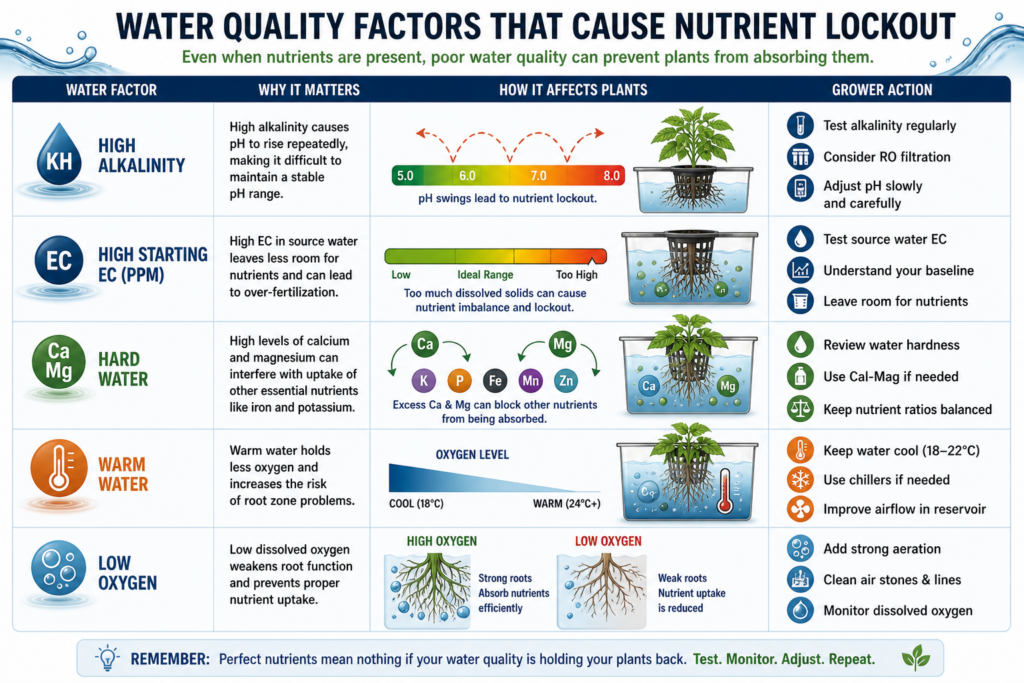
Source water matters: The water you start with can push the reservoir toward problems before nutrients are even added. Hard water may bring calcium and magnesium. Softened water may add unwanted salts. High alkalinity can cause pH to climb and can require more acid to correct. Poor-quality water can contribute to nutrient toxicity or deficiency problems over time [1][3].
Alkalinity is not the same thing as pH. pH tells you how acidic or basic the water is at that moment. Alkalinity tells you how strongly the water resists pH change. High alkalinity can make pH correction frustrating because the reservoir keeps drifting back up. One guide notes that high alkalinity above 160 ppm may require more acid to move pH, while low alkalinity below 40 ppm can make pH change constantly [2].
| Water Factor | Why It Matters | Grower Action |
|---|---|---|
| High alkalinity | Can cause pH to rise repeatedly | Test alkalinity, consider RO, adjust carefully |
| High starting EC | Leaves less room for nutrients | Test source water before mixing |
| Hard water | May affect calcium and magnesium balance | Review nutrient line and Cal-Mag use |
| Warm water | Holds less oxygen | Improve aeration and monitor temperature |
| Low oxygen | Weakens root function and uptake | Add aeration, clean roots, check pump |
Reverse osmosis water can help when tap water is inconsistent, high in EC, or high in alkalinity. RO water is not magic, though. It usually needs a complete hydroponic nutrient program and, depending on crop and formula, may need calcium and magnesium support.
When Should You Flush, Dilute, or Fully Reset the Reservoir?
Flush or reset the reservoir only when pH correction or dilution cannot restore a clean, stable, crop-appropriate solution. Sometimes pH correction is enough. Sometimes dilution is better. Sometimes the safest move is a full reservoir reset.
Use pH correction when EC is reasonable, roots look healthy, the reservoir is fresh, and the main issue is pH drift. Use dilution when EC is clearly too high but the solution is not old, contaminated, or unbalanced. Use a full reset when the reservoir is old, smells off, has slime, has repeated pH swings, has unknown inputs, or has been topped off many times without a clean change.
Example EC recovery chart:
Day 0: EC too high, plant shows burnt tips and slow uptake
Day 1: dilute or reset, bring EC back near crop-appropriate range
Day 3: pH stabilizes, water uptake improves
Day 7: new growth looks cleaner
Day 14: feeding can be increased carefully if the plant is responding
This example is not a universal prescription. The correct EC depends on crop, stage, lighting intensity, temperature, and system type [1][3].
Grow Big Pro Tip: Old damaged leaves may not fully recover. Judge success by new growth, root color, water uptake, and steadier pH.
How Do You Recover Plants Without Overfeeding Them?
Recovery is controlled, not aggressive: Once you correct the cause, resist the urge to push hard feed immediately. A stressed root system needs stability. Start mild, watch the response, and rebuild strength gradually. If you reset the reservoir, use a clean, crop-appropriate nutrient mix, check EC, then adjust pH after the nutrients are fully mixed and circulated [1].
A practical recovery timeline looks like this:
24 hours: pH and EC should be more stable, but leaves may still look rough.
3 days: water uptake may improve, and new growth may begin looking less distorted.
7 days: plant direction becomes clearer. Healthy new tips are a strong sign.
14 days: old damage remains, but the plant should be actively growing if the root zone is stable.
Root health is just as important as chemistry. Roots need oxygen to function and support nutrient uptake. Dissolved oxygen above 6 ppm is listed as an optimum water-quality parameter for hydroponic production, and warmer water holds less oxygen [2]. In DWC and other water-heavy systems, nutrient issues often overlap with oxygen and temperature issues.
Which Tools Make Diagnosis Faster and More Accurate?
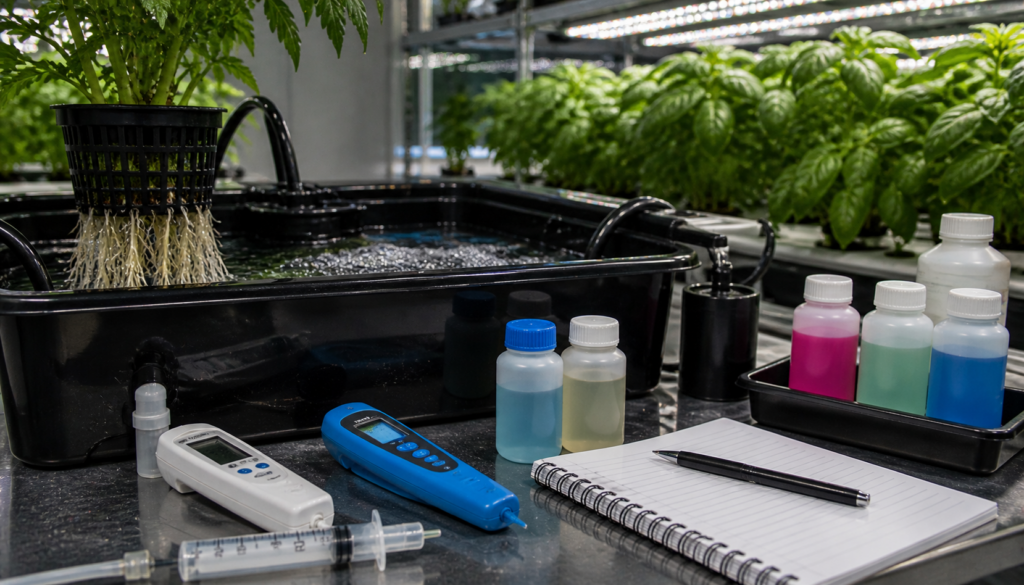
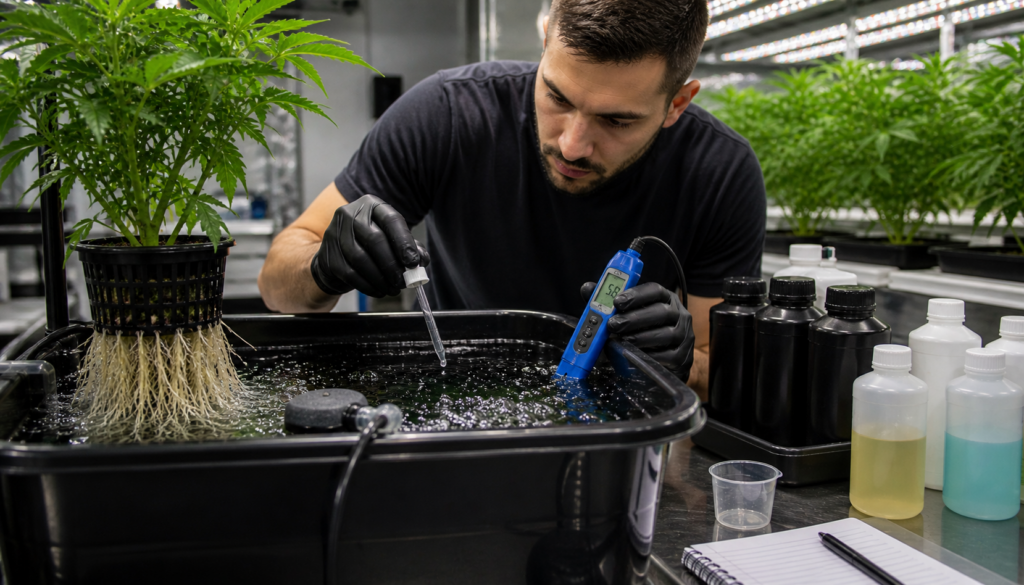
The right tools save the grow: A grower who can measure pH, EC, water temperature, and reservoir behavior has a major advantage over someone guessing from leaf color. Meters do not replace experience, but they turn a confusing plant problem into a solvable process.
Core troubleshooting tools:
- pH meter
- EC or PPM meter
- Fresh pH 4 and pH 7 calibration solution
- EC calibration solution
- Water thermometer
- Clean measuring syringes or beakers
- Reservoir logbook
- Air pump and air stones
- Clean reservoir and pump parts
- Optional dissolved oxygen meter for advanced systems
Meters must be calibrated and cared for. Calibration aligns readings to known reference values, and monthly calibration is commonly recommended for pH tools, with more frequent checks for heavy use. pH probe tips should stay hydrated, and dry probes may need rehydration before accurate use [7][8].
Grow Big Pro Tip: A cheap meter that is not calibrated can create expensive problems.
Need help diagnosing it: Not sure if it is lockout, deficiency, or burn? Bring your pH and EC readings to Grow Big Hydro, and we will help you troubleshoot the next move.
How Can You Prevent the Same Problem Next Cycle?
Prevention is a habit: Most lockout problems are not random. They usually come from drift, buildup, untested source water, poor meter care, unstable reservoir routines, or roots growing in low-oxygen conditions. A simple log can prevent the same issue from repeating.
Weekly reservoir log:
Date:
Crop and stage:
Reservoir gallons:
pH reading:
EC or PPM reading:
Water temperature:
Top-off amount:
Nutrients added:
Plant response:
Notes on roots:
For small-scale systems, pH and EC should be checked weekly and when source water is added. Some intensive systems benefit from daily checks, especially during fast growth, heavy feeding, warm weather, or flowering and fruiting stages [1][3]. Reservoirs should also be cleaned between crop cycles, and nutrient solution should be changed when crop performance slows or when the solution becomes difficult to stabilize [3].
Build your testing kit: Shop reliable pH meters, EC meters, calibration solution, hydroponic nutrients, RO water systems, air stones, and reservoir cleaning supplies to build a cleaner routine.
What Are the Biggest Mistakes Growers Make During Recovery?
Mistake one: Adding more nutrients before testing. This is the classic lockout trap. The plant looks deficient, so the grower feeds harder. If pH or EC is already wrong, that extra feed may increase stress.
Mistake two: Chasing pH too aggressively. pH should be adjusted slowly, mixed thoroughly, and rechecked after the solution stabilizes. Fast corrections can create unstable swings [1].
Mistake three: Ignoring oxygen and roots. A perfect reservoir reading does not help if roots are brown, slimy, too warm, or starved for oxygen. Root function supports nutrient uptake [2].
Mistake four: Mixing incompatible products. Some concentrates should not be mixed together before dilution because precipitation can make nutrients unavailable. Always follow the nutrient line’s mixing order and dilute concentrates properly [2][6].
Mistake five: Trusting an uncalibrated meter. If the tool is wrong, every correction after that may be wrong too [7][8].
What Should Illinois and USA Growers Keep in Mind?
Local conditions matter: Illinois growers can see major seasonal swings in indoor water temperature, room humidity, and source-water behavior. Winter basements may run cooler. Summer rooms may run warmer. Municipal water can differ from well water, and even the same building may see changes after filtration, softening, or plumbing differences.
Hydroponics gives growers greater control, but it also requires more management. A power interruption, pump issue, or reservoir mistake can affect plants quickly because the nutrient solution is the root environment [4]. That is why local support matters. When a grower brings pH, EC, water temperature, system type, crop stage, and a few clear plant photos, troubleshooting becomes much faster.
For USA growers, the best approach is the same: test source water, use crop-specific nutrient guidance, monitor pH and EC consistently, keep the reservoir clean, and avoid stacking products without understanding how they interact [1][2][3][6].
What Is the Step-by-Step Rescue Workflow?
Use this order: Diagnose before correcting. Correct before feeding harder. Observe new growth before declaring victory.
- Inspect the plant. Note yellowing, burnt tips, curling, twisted growth, or stalled uptake.
- Check the roots. Look for white or cream roots, healthy branching, and no foul smell.
- Test reservoir pH. Compare it to the crop’s expected range.
- Test EC or PPM. Decide whether the solution is too strong, too weak, or unstable.
- Check water temperature and aeration. Add oxygen support if needed.
- Review source water. Look at starting EC, alkalinity, hardness, and whether RO may help.
- Correct pH slowly or dilute high EC if appropriate.
- Reset the reservoir if the mix is old, unknown, contaminated, or unstable.
- Feed mild after correction. Let the plant recover before increasing strength.
- Track changes for 7 to 14 days and judge by new growth.
Compact troubleshooting flow:
Plant looks deficient → Check pH → Check EC → Inspect roots → Check water temperature and oxygen → Review water quality → Correct slowly → Watch new growth
What Questions Do Growers Ask Most About Recovery?
Should I flush every time? No. If pH is the only problem and EC is reasonable, a careful pH correction may be enough. Flush or reset when EC is too high, the reservoir is old, roots are stressed, or the solution is unknown.
Can old leaves recover? Sometimes color improves slightly, but old damaged tissue often remains damaged. The real sign of recovery is healthier new growth.
Can Cal-Mag fix lockout? Only if the issue is truly related to calcium or magnesium availability. If the real cause is pH, EC, alkalinity, or root stress, adding more supplements may not solve it.
How fast should plants bounce back? Some improvement in uptake may happen within a few days, but visible recovery usually takes longer. Give the plant 7 to 14 days and focus on fresh growth.
What should I bring for help? Bring pH, EC or PPM, water temperature, nutrient brand and feed rate, reservoir size, source water type, crop stage, and clear photos of leaves and roots.
Key Takeaways
- Test pH and EC before adding more nutrients.
- Correct pH slowly and avoid chasing numbers too aggressively.
- Use EC as a nutrient-strength guide, not a complete nutrient balance test.
- Check roots, water temperature, and oxygen because uptake depends on root health.
- Track new growth for recovery instead of expecting old damaged leaves to heal.
References
pH & EC Basics
[1] Electrical Conductivity and pH Guide for Hydroponics
[5] Hydroponics at Home
Nutrient Solutions
[2] Hydroponic Nutrient Solutions
[6] How to Select the Right Fertilizer for Hydroponics
Water & System Factors
[3] Small-Scale Hydroponics
[4] Home Hydroponics
Meter Care
[7] Care, Calibration & Maintenance
[8] pH Probe Care, Maintenance and Storage