

Why “spray and pray” fails indoors
Indoor gardens compress biology into tight spaces with stable temperatures, abundant light, and continuous host plants—perfect for explosive pest growth. A data‑driven program that emphasizes prevention, correct identification, monitoring, clear action thresholds, and the least‑disruptive controls consistently outperforms ad‑hoc spraying [1][2]. This approach reduces resistance, protects beneficials, and keeps you on the right side of label and state rules in Illinois and across the USA [3][14][18].
What the pros say (summary): Extension specialists stress prevention and monitoring first, rotating chemistries by mode of action only when needed, and using biologicals early to avoid wipeouts later [5].
Table of Contents
Integrated pest management indoor garden: your 7‑step framework
- Identify the pest correctly → 2) Monitor and record → 3) Define action thresholds → 4) Remove stress & fix cultural issues → 5) Deploy biological controls → 6) If needed, apply selective, label‑legal chemistries by MoA → 7) Review outcomes, adjust thresholds, and prevent re‑introductions next cycle [1][2][10].
Know your enemies: top indoor pests (signs, speed, hotspots)
Twospotted spider mite (Tetranychus urticae). Fine stippling, bronze leaves, and webbing on leaf undersides; populations rocket in warm, dry rooms. At ~82°F (~28°C), egg‑to‑adult can be ~8 days—which means exponential growth inside tents or rooms [3]. Hotspots: plants near fans/edges and warm fixtures.
Western flower thrips (Frankliniella occidentalis). Silvery scarring on leaves/flowers and peppery frass; vector tospoviruses in ornamentals. Development can be ~7–15 days depending on temperature—short enough that missing a week of scouting hurts [4][5]. Hotspots: top growth, flowers, intake vents.
Fungus gnats (Bradysia spp.). Adults are weak fliers; the damage is from larvae grazing roots and algae in wet media. Life cycle typically 2–4 weeks depending on temperature and moisture [6][7]. Hotspots: over‑watered media, algae in trays and lines.
Figure 1—Approximate life cycles (egg → adult) under warm indoor conditions
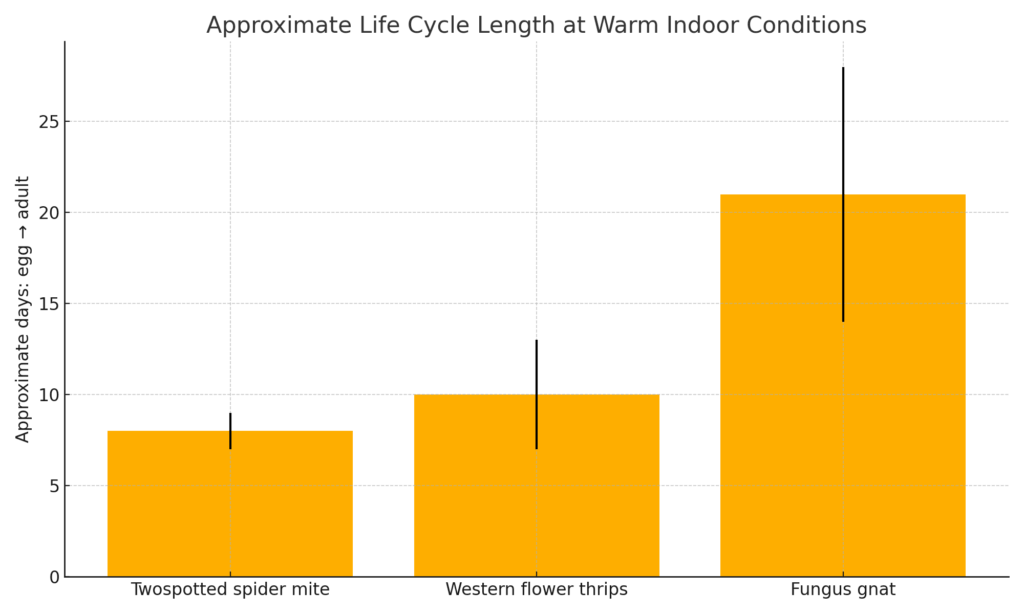
Notes: Central estimates plotted with simple ranges from university/extension sources [3][4][6][7]. Use them to time scouting and releases, not as crop‑specific absolutes.
Scouting that actually works (cards, counts, cadence)
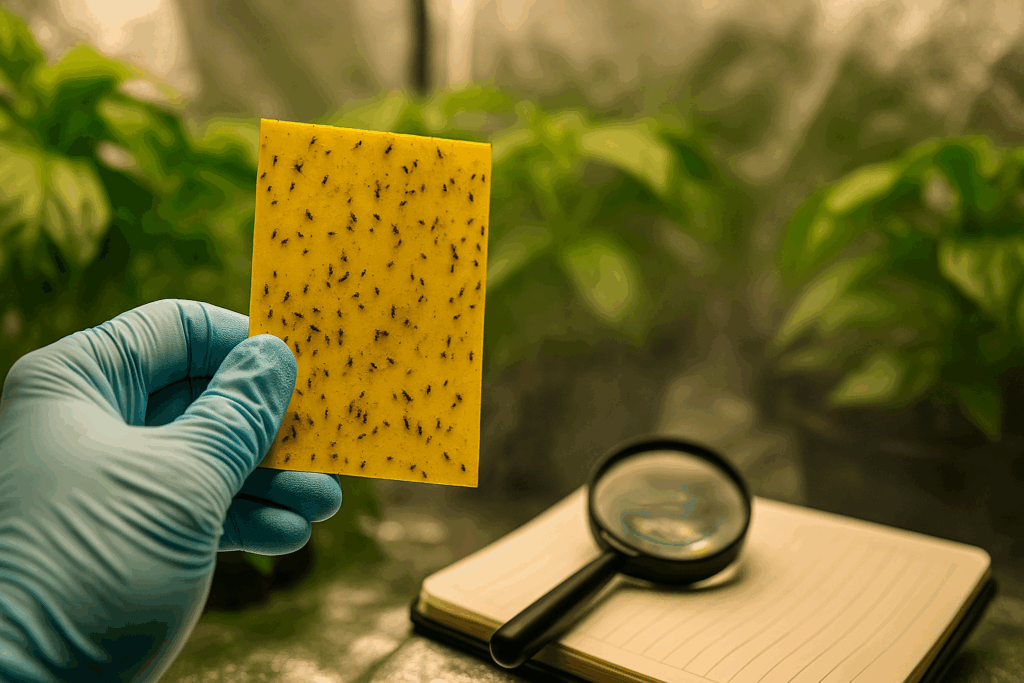
Sticky cards catch flying adults (thrips, whiteflies, fungus gnats). As a baseline: place 3–4 cards per 1,000 sq ft (minimum 1 per 1,000 sq ft), add more near doors/vents, and keep them just above the canopy; blue cards bias to thrips, yellow are general‑purpose [9]. Count weekly, graph trends, and adjust card density when using winged beneficials [9].
How many is “too many”? Thrips thresholds vary by crop and risk tolerance. A practical starting point is ~15 thrips per yellow card per week per 1,000 sq ft, then refine per your crop and virus pressure [8]. Track trends, not single spikes.
Plant inspections still matter. Tap leaves over white paper to detect mites; inspect upper growing tips for thrips; look for algae and shore flies near wet floors or trays [19][9].
Figure 2—Example thrips counts vs. threshold (weekly)
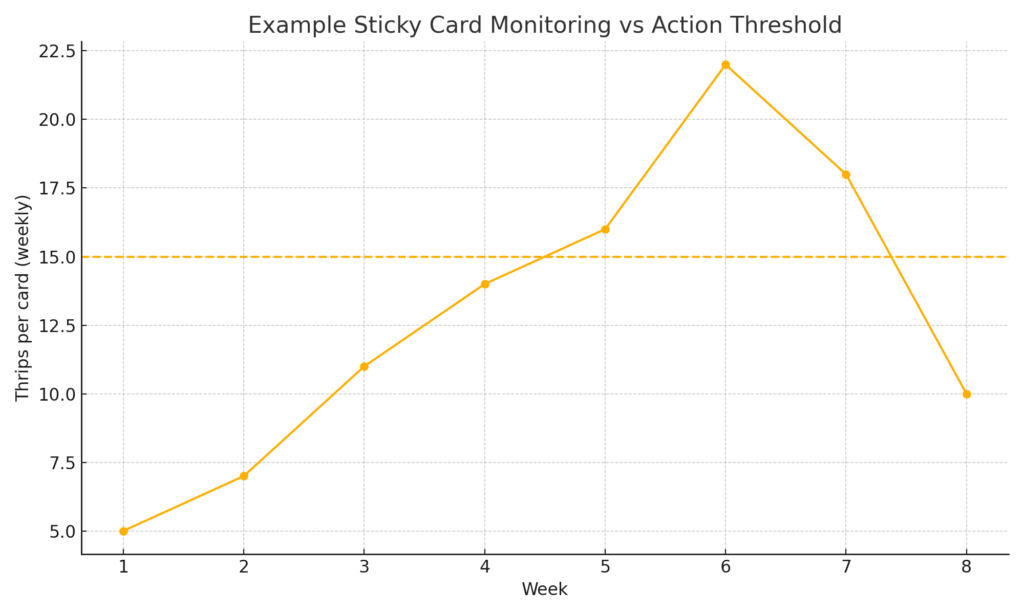
How to read it: The dashed line is the starting action threshold [8]. Weeks 5–6 exceed the line—triggering releases or spot sprays plus cultural fixes.
Cultural fixes: starve pests, strengthen plants
- Water & media: Let the top 1–2 cm dry between irrigations (where crop tolerates); fix leaks and slope trays to stop algae—key for fungus gnats [7].
- Sanitation: Remove crop debris; quarantine new plants; clean intake filters; seal light leaks in tents that attract flying adults [5][9].
- Climate: Keep VPD and airflow in spec; avoid hot, dry corners where mites explode [3].
Biological controls that work indoors (with starting release rates)
- Phytoseiulus persimilis (Spidex) for spider mites. Starting rate: 2–50 mites/m², release 1–2× at weekly intervals; start at first detection [11].
- Amblyseius (Transeius) swirskii (Swirski‑Mite) for thrips/whitefly larvae. Starting rate: 25–300 mites/m², repeat as needed [12].
- Stratiolaelaps scimitus (Entomite‑M; formerly Hypoaspis miles) for fungus gnat larvae and thrips pupae in media. Starting rate: 100–500 mites/m², preventive or at first signs [13].
Pro tips:
- Release early and locally (near hotspots).
- Pair soil predators with surface sanitation to break gnat cycles.
- Check compatibility tables if you must spray; many broad‑spectrum chemicals harm beneficials [5].
Selective chemistries & resistance management (MoA rotation)
If monitoring exceeds your threshold and cultural/biological tactics can’t catch up, use selective products and rotate MoA groups to avoid resistance. Extension guidance emphasizes no more than two sequential applications from the same MoA before rotating [5]. Always obey the label; it is a legal document under federal law [18].
Common low‑impact options in indoor settings (examples): insecticidal soaps, horticultural oils, microbials (e.g., Beauveria bassiana), botanical actives, and EPA 25(b) minimum‑risk products where appropriate [19][17]. Verify crop safety first and achieve complete coverage (upper and lower leaf surfaces) [19].
Label reality check (USA & Illinois): Use only products labeled for your crop and indoor/greenhouse sites. In Illinois, Restricted Use Pesticides require licensure; homeowners may apply general‑use products on their own property, but not RUPs [15][16]. Cannabis cultivators have additional, crop‑specific restrictions (see Illinois Admin. Code) [21]. Always follow PPE and REI statements on the label [18].
Spray timing & technique that actually hit the target
- Timing: For contact products (soaps/oils), spray when pests are exposed (e.g., thrips larvae on foliage; mites on undersides). Avoid spraying during peak heat or full lights to reduce phytotoxicity; run lights down or off and ensure airflow for fast drying.
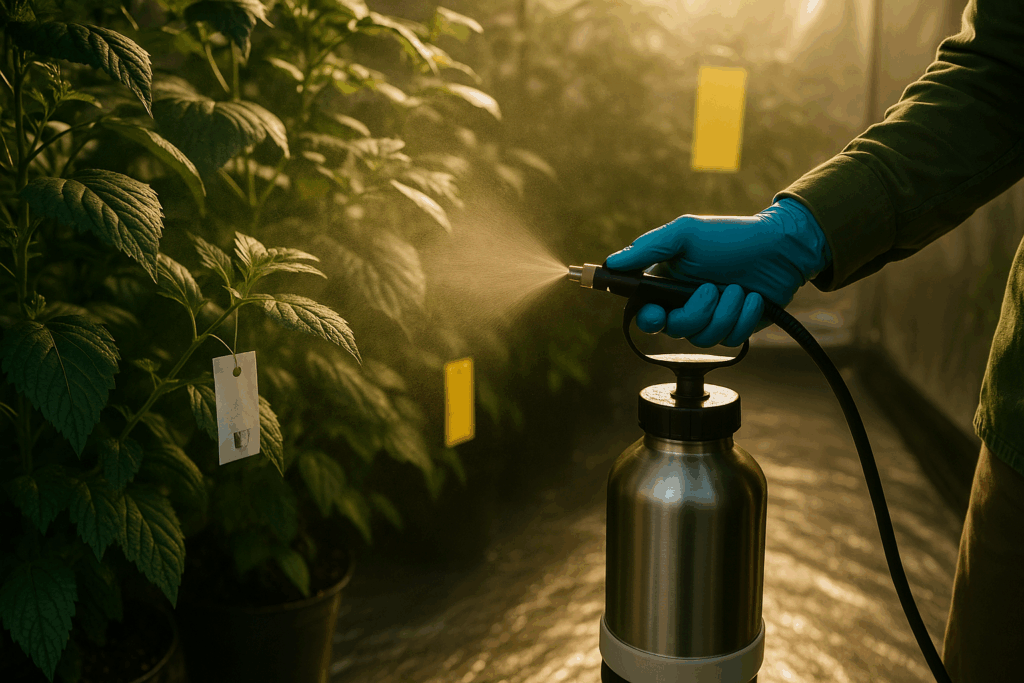
- Coverage: Aim for thorough wetting without runoff; use a fine‑to‑medium droplet and angle the wand under leaves. Repeat per label intervals (often 3–7 days) to contact new hatchlings.
- Compatibility: Check biocontrol compatibility charts before and after releases; many oils/soaps may be OK with soil predators but can harm foliage‑dwelling mites—confirm first [5][11–13].
Building your thresholds (start here, then refine)
- Sticky cards (thrips): Begin with ~15 adults/card/week/1,000 sq ft; lower threshold if virus‑risk crops are present; raise slightly for rugged, non‑flowering crops [8][9].
- Mites (leaf checks): Sample 20–30 leaves across the room weekly; if an increasing fraction has mites or you record moving hotspots, trigger releases or spot sprays [3][19].
- Fungus gnats (soil checks): Sticky cards at soil level plus media probes and potato slices; trigger action when larvae are routinely observed and adults trend upward [7][9].
Illinois & USA compliance notes (plain language)
- “The label is the law.” All pesticide labels are legally enforceable in the USA [18].
- Minimum‑risk (25b) actives (e.g., certain oils, citric acid) are exempt from federal registration, but must still follow ingredient and state rules; check the EPA lists and Illinois allowances [17].
- Licensing: In Illinois, RUPs require licensure; applying pesticides for hire or on property you don’t own can trigger licensing requirements [14][16].
- Crop‑specific rules: Certain Illinois rules apply to cannabis cultivation; review state administrative code before use [21].
Putting it together: a 90‑day example program
Weeks 1–2 (Set the baseline): Install sticky cards (3–4/1,000 sq ft; extra at doors/vents). Map hotspots, start a log. Fix leaks, dry surfaces, increase airflow at corners. Quarantine new plants. If mites or thrips are detected, plan early biocontrol releases [9][11–13].
Weeks 3–6 (Prevention phase): Release soil predators preventively for gnats; deploy swirskii in crops with flower/soft growth; consider persimilis at first mite finds. Graph weekly counts; compare to your threshold line (see Figure 2).
Weeks 7–12 (Stabilize & refine): If counts exceed threshold, spot‑treat with compatible options and rotate MoA as needed; continue sanitation. Update thresholds per crop: lower for flowering ornamentals or premium greens; slightly higher for hardy veg starts [5][8][9].
Key takeaways
- Act early. Short life cycles (7–15 days for thrips; ~8 for mites in warm rooms) make weekly scouting non‑negotiable [3][4].
- Stack tactics. Cultural + biological controls reduce spray frequency and resistance risks [1][5].
- Measure, don’t guess. Use sticky cards, leaf checks, and simple graphs to decide, not hunches [8][9].
- Stay compliant. Follow labels and Illinois rules; choose minimum‑risk options when appropriate [17][18].
References
🌿 Core IPM Principles
[1] U.S. EPA – Integrated Pest Management (IPM) Principles
https://www.epa.gov/safepestcontrol/integrated-pest-management-ipm-principles
[2] USDA NIFA – Integrated Pest Management Program
https://www.nifa.usda.gov/grants/programs/integrated-pest-management-program-ipm
🕷️ Key Pests & Biology
[3] UC ANR IPM – Twospotted Spider Mite (Floriculture & Ornamentals)
https://ipm.ucanr.edu/agriculture/floriculture-and-ornamental-nurseries/twospotted-spider-mite/
[4] MSU Extension – Understanding Western Flower Thrips
https://www.canr.msu.edu/news/understanding_western_flower_thrips
[5] Texas A&M AgriLife Extension – Western Flower Thrips Management Guide (HORT-PU-285, 2023)
https://extensionentomology.tamu.edu/wp-content/uploads/2025/03/grower-fact-sheet-western-flower-thrips-management-guide.pdf
[6] Colorado State University Extension – Fungus Gnats as Houseplant and Indoor Pests
https://extension.colostate.edu/resource/fungus-gnats-as-houseplant-and-indoor-pests/
[7] University of Wisconsin Horticulture – Fungus Gnats and Shore Flies in Greenhouses
https://hort.extension.wisc.edu/articles/fungus-gnats-and-shore-flies/
📊 Monitoring & Thresholds
[8] Rutgers Plant & Pest Advisory – Pest Counts & Action Thresholds in the Greenhouse
https://plant-pest-advisory.rutgers.edu/pest-counts-action-thresholds-in-the-greenhouse/
[9] UConn Extension – Using Sticky Cards to Monitor for Greenhouse Insects
https://ipm.cahnr.uconn.edu/wp-content/uploads/sites/3216/2022/12/2019stickycardsfactsheet-1.pdf
[10] UC ANR IPM – Monitoring with Sticky Traps
https://ipm.ucanr.edu/agriculture/floriculture-and-ornamental-nurseries/monitoring-with-sticky-traps/
🪲 Biological Controls
[11] Koppert Biological Systems – Spidex (Phytoseiulus persimilis)
https://www.koppert.com/spidex/
[12] Koppert Biological Systems – Swirski-Mite (Amblyseius swirskii)
https://www.koppert.com/swirski-mite/
[13] Koppert Biological Systems – Stratiolaelaps scimitus (Hypoaspis miles)
https://www.koppert.com/crop-protection/biological-pest-control/predatory-mites/stratiolaelaps-scimitus-hypoaspis-miles/
⚖️ Laws, Labels & Safety (USA + Illinois)
[14] Illinois Department of Agriculture – Pesticide Use & Regulation
https://agr.illinois.gov/pesticides/pesticide-use-and-regulation.html
[15] Illinois General Assembly – Illinois Pesticide Act
https://www.ilga.gov/legislation/ilcs/ilcs3.asp?ActID=1596&ChapterID=36
[16] Illinois Department of Agriculture – Certification & Licensing
https://agr.illinois.gov/pesticides/certification-and-licensing.html
[17] U.S. EPA – Active Ingredients Allowed in Minimum-Risk (25b) Products
https://www.epa.gov/minimum-risk-pesticides/active-ingredients-allowed-minimum-risk-pesticide-products
[18] U.S. EPA – Introduction to Pesticide Labels (“The Label Is the Law”)
https://www.epa.gov/pesticide-labels/introduction-pesticide-labels
[19] University of Illinois Extension – Managing Spider Mites in the Garden and at Home
https://extension.illinois.edu/blogs/good-growing/2022-08-26-managing-spider-mites-garden-and-home
[20] UC ANR IPM Phenology – Twospotted Spider Mite Model
https://ipm.ucanr.edu/PHENOLOGY/ma-2spotted_spider_mite.html
[21] Illinois Admin Code tit. 8, § 1000.470 – Cannabis Pesticide Usage Rule
https://www.law.cornell.edu/regulations/illinois/Ill-Admin-Code-tit-8-SS-1000.470